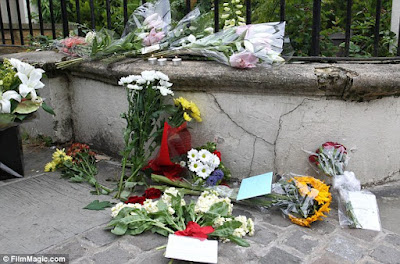
I love Heath Ledger, and was so saddened when I heard he had died. He was a brilliant actor with such promise, as well as a gentle soul. His death still marks many worldwide, three years later.
However, watching the new ShowTime series, "The Borgias", by Academy Award Winner Neil Jordan, I was suddenly struck by how the young Cesare Borgia, played by Quebecer Francois Arnaud, was able to completely hold his own against Academy Award Winner and acting guru Jeremy Irons (Rodrigo Borgia)... and almost, even, stole the whole show from him. Arnaud is intense, and his presence captures your attention. For this reason, especially after having watched him as a then 19-year-old in Les grandes chaleures, I do believe Arnaud will become the next Heath Ledger. I just pray he doesn't suffer the same fate as the Academy Award Winner made known to North America thanks to the iconic movie "10 Things I Hate About You".
Francois Arnaud in a scene from the critically acclaimed "The Borgias" (2011).
Heath Ledger in the "10 Things I Hate About You"
Here is a clip of Arnaud in the extended trailer for "The Borgias", and I hope that you will catch a glimpse of what I mean.
This was the scene on St-Laurent Blvd and Bourassa St
At around 5 PM today there was a minor accident at an intersection on St-Laurent Boulevard. With the way people drive on this street, I'm surprised it doesn't happen more often.
The white car was mostly undamaged, except for its tail-pipe being completely severed and lying on the street not too far from the scene above. The black car, however, took a lot of damage. The very front of the car was buckled, and they even lost the company logo on the front of the car.
Obviously, the white car probably braked sharply, and the other driver following too close behind, the black car rear-ended the 1st car.
Canada’s crime rate at lowest level in almost 40 years: StatsCan
Jill Mahoney
Globe and Mail Last updated
Canada’s crime rate continued its long decline last year, hitting the lowest level since 1973.
Crimes reported to police dropped 5 per cent in 2010. The decline spanned a wide range of offences, including the homicide rate, which fell by 10 per cent to a level not seen since 1966.
“Homicide is one of the few types of violent crime that almost invariably comes to the attention of police and, as such, is generally recognized as a country’s barometer of violence,” Statistics Canada said in a report released Thursday.
In addition, an index measuring the severity of crimes fell 6 per cent from 2009, reaching its lowest point since it was introduced in 1998.
The national crime rate has been dropping steadily for the past 20 years. However, the Conservative government argues that the crime is on the rise and plans to introduce a tough law-and-order package in the House of Commons in the fall.
Prime Minster Stephen Harper’s government has long looked to victimization surveys rather than the official crime rate, which is based on offences reported to and substantiated by police. Statscan’s last victimization survey found that Canadians reported just 31 per cent of criminal incidents to police in 2009.
Winnipeg Police Chief Keith McCaskill says he's working to lower his city’s crime rate as the Manitoba capital was once again painted as the most violent major metropolitan area in the country.
But Chief McCaskill says he takes comfort that the rate is going down.
The violent crime severity index for the city dropped by 13 per cent last year compared with the previous year. Manitoba is also once again leading the provinces in violent crime. Statistics Canada says there were 3.6 murders for every 100,000 people in Manitoba last year.
On the day the numbers came out, Chief McCaskill's police force was dealing with two shootings — one involving a robbery suspect shot by police and another a man wounded in an unexplained incident downtown.
Overall, Canadian police forces reported nearly 2.1 million Criminal Code offences last year, about 77,000 fewer than in 2009. The figures do not include traffic violations.
Statscan credited four property crimes for the majority of the drop in the crime rate: theft under $5,000, mischief, car thefts and break-ins. However, there were also fewer attempted murders, serious assaults and robberies.
By contrast, there were more sexual assaults, gun offences, criminal harassment, child pornography and drug offences in 2010.
Among Statscan’s findings:
There were 554 homicides in 2010, down 56 from the year before. The decline in the homicide rate was largely driven by a decrease in British Columbia, where the rate hit an all-time low.
There were 693 attempted murders last year, down from 801 in 2009. This resulted in the lowest level in more than 30 years.
Nearly 93,000 vehicles were reported stolen last year, representing a 15 per cent drop and continuing a downward trend that started in the mid-1990s.
Nearly 153,000 youth between the ages of 12 and 17 were accused of a crime in 2010, almost 15,000 fewer than a year earlier. The youth crime rate declined by 7 per cent.
More than 22,000 sexual assaults were reported in 2010, an increase of 5 per cent. The higher number represented the first increase since 2005.
Drug offences rose 10 per cent from 2009, continuing an upward trend. About half were for marijuana possession.
Three cities had increases in their crime severity index, which measures the seriousness of crimes: St. John’s, Sudbury, Ont., and Peterborough, Ont. The cities with the lowest crime severity indexes were Guelph, Ont., Quebec City, Toronto and Ottawa.